
With 93% of Fortune 500 CHROs using AI in their HR processes, the technology is already beginning to reshape people functions and organisations. However, George Kunnath, Director of Business Intelligence and Technology at the Roffey Park Institute, told delegates at the SPDS Conference that as yet, particularly in the public sector, AI remains very much in experimentation mode, with few organisations having formally embedded it into organisational processes. “AI is coming into HR in early stages, but it’s not yet institutionalised,” he said.
That provides an opportunity for HR to think about how the function can play a leading role in the successful implementation of a technology that will change all our working lives.
Kunnath cited research that 60% of CEOs say AI implementation success is not about the tech, but about the people. “The success of AI implementation is linked to culture, and whether we have the right culture,” Kunnath said. It is incumbent on HR leaders to take a lead in this emergent and fast-moving space, taking a human-centered approach to AI that ensure organisations keep people at the heart of strategy.
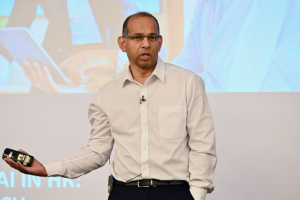
Here are eight practical ways Kunnath suggests HR leaders go about doing so…
1. Mitigate the fear factor through employee involvement
“AI will have impacts, and that brings a level of anxiety [to the workforce],” Kunnath said. To mitigate some of this understandable anxiety, he advised engaging stakeholders from across the organisation, including employees, staff networks and unions, early to co-create AI adoption pathways and build trust. “Make sure that they are involved in the process, because if they are part of the process, they will guide it and they will make it happen,” he said.
2. Build trust through transparency
Transparency builds trust in all areas, and this is no different. Kunnath stressed the importance of transparent communications, including clearly documenting AI capabilities and using open demos and Q&A sessions to address employee concerns. “AI can’t do everything,” he explained. “It’s worth telling your people what AI will do and what AI won’t do. Having limits brings a degree of trust. Be very transparent to your employees about how you want to use AI.”
3. Create a learning culture
“AI won’t replace people but people with AI will replace people without AI,” Kunnath said. “So, the more you can get your people to work with AI, the more you are securing their future.” With skills becoming obsolete faster than ever before, HR leaders must focus on building both confidence in using AI, empowering colleagues to “experiment with confidence”, and strengthening the human skills that differentiate people in a machine-driven world. This includes critical thinking, which becomes even more important. “AI often generates junk,” warned Kunnath. “You have to learn the skill of critical thinking. The job is moving from the skill of preparing the report to [assessing the report].”
4. Deconstruct and reconstruct roles
Much of change management in the near future will be based on deconstructing and reconstructing roles in the organisation, Kunnath predicted. That means taking a role and deconstructing into three parts: the part that only a human can do, the part a human will do best with AI as a helper, and the part that AI can do on its own. You then reconstruct the role based on those answers, with a focus on human-centered skills.
5. Align AI with organisational values
“AI will only succeed when we can combine organisational values and culture to allow AI to come in,” said Kunnath. “Successful AI in HR depends on harmony with existing values and culture.” Alignment is key, and HR leaders should take deliberate efforts to ensure AI technologies align with company values. “AI is going to reveal your culture and values,” said Kunnath, explaining that as AI is programmed to do what you say will do, it can often reveal tensions and gaps between stated values and workplace practices.
6. Establish governance structures and ethical frameworks
HR in the public sector has a key leadership role to play in the ethical governance of AI, Kunnath stressed. “The Scottish Parliament’s AI playbook talks about fairness, inclusion, accountability and transparency,” he said. “Who is going to ensure that in the organisation if not you?” In practice, that means setting up AI steering groups and ethics committees and designing ethical AI frameworks, as well as considering how to balance innovation with issues like data protection or bias. HR should be designing “human-in-the-loop processes” to “ensure AI is not making decisions about people and that affect their lives without a human in the loop.”
7. Leaders must role model
“Leadership shapes AI culture,” said Kunnath. Leaders must set reasonable expectations around the role of AI, not buying into it as a silver bullet but nonetheless clearly seeing how it can improve productivity. They should influence AI adoption by creating safe spaces for staff to explore AI rather than making its usage mandatory, encouraging experimentation through iterative pilots and celebrating small wins.
8. HR leaders must take agency
AI capability is increasing at pace. Now is the time for HR leaders in the public sector to step up and play a key leadership role in defining the future, working closely with their colleagues in IT. “If you are not mapping your role, someone is else is going to map it for you,” Kunnath warned. “Get into the discussions of HR’s role now. AI is here to stay, accept that and take agency. Your role as an HR leader is to ensure people stay at the centre of your organisation.”


Explore Roffey Park Institute’s latest white paper, Cultural Integration of AI in HR: A Human-Centred Approach, an insightful examination of how the success of AI in HR depends less on technology itself and more on the culture that surrounds it.
Blog by Katie Jacobs, an award-winning freelance journalist, writer and editor, who specialises in writing about the world of work. She was previously Editor of HR Magazine and Senior Stakeholder Lead at the CIPD.
0 Comments