
From virtual meetings to AI assistants, technology is reshaping every aspect of how we work. Driving digital transformation is a major challenge as well as an opportunity for HR teams and the leaders they partner, with strategic and ethical considerations to work through, and the issue of addressing tech-related anxiety among the workforce.
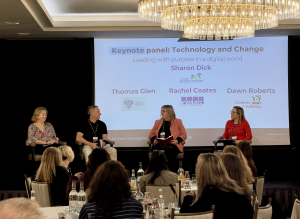
In a digital world, leading with purpose matters more than ever. So, the SPDS Conference brought together three exceptional leaders – Dawn Roberts, Chief Executive of Dumfries and Galloway Council, Thomas Glen, Chief Executive of Perth & Kinross Council and Rachel Coates, Director, People Consulting, at KPMG – to discuss how taking a people-centric approach can help organisations unleash the true potential of technology.
In conversation with Sharon Dick, Head of Human Resources and Corporate Services, East Renfrewshire Council, here are some of the key areas they explored…
The tool is just the tool: it’s how we use it that counts
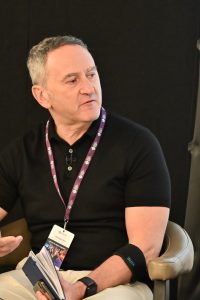
The leaders all reflected on how tools like Microsoft Teams, Zoom and smartphones had radically changed how their organisations addressed work – for good (video calls aiding inclusion, for example) and ill (smartphones blurring work/life boundaries and leading to people being ‘always on’).
But as Glen pointed out, the tool is just that: a tool. It’s how leaders use it that counts.
“The technology is irrelevant: it’s about people and purpose,” he said. “The tech should help us be better people organisations and have a stronger purpose.” He added that leaders should think about technology strategies through the lens of how they drive behaviour, improving processes and driving better outcomes for people. “There’s an opportunity with tech to look at how we improve and become much more relational in our behaviours,” he said.
Embrace agility, but remain focused on what matters

When it comes to digital transformation, leaders must be open-minded and thoughtful in how they apply strategy, said Roberts. “We need to be flexible and adaptable enough to move with the times so that we don’t become fixed,” she added. “How do we embrace the principles of experimentation and innovation in a way that makes local government more agile in how we adapt, respond and progress with our important work to serve the local community?”
She added that in her view, technology is about enhancing rather than replacing roles, enabling people to focus on what really matters: the relational aspect of local government work. “Let’s not take our eye off the ball around the core purpose of local government, which is to support our local communities, support democratic purposes and enable our communities to thrive” she urged.
Coates agreed, adding that leaders should take a people-first rather than tech-first approach. “The point is not about the technology but achieving something greater: ultimately, it is about public service. Leaders need to hold the line around that.”
Create a learning culture

When it comes to the role of leadership in driving successful technology adoption, Coates advised actively role modelling, with leaders openly using the tools they are asking others to adopt. “Experimentation is key: leaders need to set the culture where it’s OK to have a go,” she said. However, she added that leaders should set parameters and priorities to ensure time and energy is directed appropriately.
Leaders must also create the space for people to learn, she advised, allocating the right resources in terms of tools and learning materials, but also time. “There needs to be conversations and relationships around this,” she explained. “Give space in the organisation for those things.”
Roberts reflected that having a proactive learning culture that gives people space, supports them when things go wrong and celebrates wins is critical. “There needs to be a will to support people to progress and try out new things,” she added. “We need to think creatively about how we use our resources. It’s about encouraging learning throughout the organisation.”
Build skills to ensure no-one is left behind
With skills becoming obsolete faster than ever and organisations beginning to think about the deconstruction and reconstruction of roles, HR leaders must focus on building sustainable skills for the future. The rise of AI-generated content means everyone must be able to think critically, said Coates, able to appraise the information they are being served with a critical eye.
The potential impact AI is having on entry-level roles is important to consider here, she added. With many organisations considering the automation of entry- and lower-level jobs, what impact will this have on the ability of young people to build the firm foundations they need to be able to critically assess AI-generated content? Coates suggested introducing interventions like work shadowing and placements across different organisations to help increase adaptability. Developing and sharing practical ideas and opportunities across sector is also key to ensuring “nobody is left behind”, she added.
Tell a compelling story around technology
While technology will replace some roles, it has the potential to create and enhance many more. Glen advised HR leaders to work with their chief executives on how to tell a more compelling story to the workforce about how technology can help them do their jobs better, more efficiently and more enjoyably by removing frustrating bureaucracy.
“There’s an opportunity to articulate what we can do with digital,” he said. “AI is not just going to get rid of jobs: it has the potential to make a lot of stuff people just don’t like – the bureaucracy, processing and admin – redundant. It’s really exciting that if we do that right, then we can go back to allowing people to focus on what they are really interested in: working with people.”
Blog by Katie Jacobs, an award-winning freelance journalist, writer and editor, who specialises in writing about the world of work. She was previously Editor of HR Magazine and Senior Stakeholder Lead at the CIPD.
Read about our keynote on taking a human-centred approach to AI with George Kunnath at Roffey Park here.
0 Comments