

CIPD Chief Executive, Peter Cheese, addressed the SPDS Annual Conference just days after announcing his retirement from leading HR’s professional body, stepping down after 14 years of service.
In a wide-ranging keynote about the future of work and the future of the profession, Cheese called on HR leaders to step up in the face of recent criticism in the media, focusing on outcomes and better articulating the value HR done well brings to organisations. “Let’s step back: what are we going to refocus on, and how do we make sure we’re focused on why we do these things, and why they are important for business outcomes,” he said.
He stressed that “the future of work is human”, giving ideas of where HR leaders should focus when it comes to adding value in a fast-changing world.
Use technology to create better work
AI has the potential to radically rewire organisations and how we all work; HR must be on the front foot. “AI is something we have to embrace and lean into,” Cheese said. That involves both embracing AI to automate the more administrative aspects of HR, freeing people teams up “to do the things that make a difference”, and shaping jobs for the future of work (what Cheese termed Industry 4.0).
HR leaders should work with cutting-edge technologies to design better roles, considering the aspects that make up a good job (see the CIPD’s Good Work definition for more), as well as ensuring organisations and individuals have the skills required for the future. “The more we talk about technology, the more we are talking about people, making sure that we’re supporting people and building meaningful jobs for them,” said Cheese.
Future-proof skills
The rise of AI makes critical thinking more important than ever. Cheese encouraged HR leaders to experiment with AI tools in order to both “appreciate their power – and also [learn] that they are not perfect”. Critical thinking is key to sniffing out hallucinations (AI making things up) and avoiding ‘workslop’ (AI-generated work that lacks substance). “It will always be true that we need to develop and support the idea of critical thinking and curiosity – we can start with ourselves,” said Cheese.
He warned organisations against reducing entry level intakes to cut costs via automating junior roles, as this could lead to a damaging lack of experience in younger people. “We have to continue to develop the next generation,” he urged. As the half-life of skills (the length of time it takes for a skill to become obsolete) continues to decrease, HR teams will be under pressure to upskill and reskill people more regularly, he added.
Treat wellbeing as an outcome
Cheese cited Charlie Mayfield’s recently published Keep Britain Working report, which has urged employers to tackle health-based economic inactivity. “We have over 9 million people across the UK who are not economically active,” said Cheese. “Organisations have a duty to support people back into work.”
He added that organisations should have a goal of creating jobs that are good for people, building a culture where health and wellbeing, including mental health, are openly discussed. “This is a central business agenda,” he pointed out, calling on HR leaders to focus on making the business outcomes of wellbeing more obvious, such as reducing absenteeism and improving productivity.
Get serious about strategic workforce planning
Strategic workforce planning (SWP) must be a core capability of HR, with the function taking a lead on the capabilities required to drive the organisation’s strategy, and where to get them – “buy, build, borrow or bot”, as Cheese put it. “These are big questions, and we won’t solve them on our own – we’ve got to work with business leaders, mapping the organisation for the future,” he added.
Success in SWP means getting out of reactive, firefighting mode, creating the space to think ahead to what’s next and building future capabilities and workforce models. “How do we create organisations, cultures and people that can respond to change?” he asked.
Frame through the lens of value enhancement
The future of HR should be seen through the lens of value enhancement (areas like productivity, innovation, wellbeing and engagement), not just risk management (compliance, regulation and policies) and cost control. While Cheese acknowledged the biggest cost in the organisation is usually people, he said HR needed to get better at articulating value as much as understanding cost (and inevitably doing more with less).
“Anyone can cut costs: the issue is doing it a way that doesn’t damage long-term value – and how you understand what those value outcomes are,” he said. He added that HR might need to educate other leaders in strategic HR. “If you’ve got a business strategy, they might talk about marketing strategy, product strategy or financial strategy. But if you’re not thinking about people, skills and culture, it’s like sitting on a chair with a missing leg.”
Invest in your own skills and professionalism
HR professionals can often be the “cobblers’ children” when it comes to investing in developing themselves, said Cheese. “We are so worried about everyone else’s skills and capabilities, but we have not done enough for our own,” he added, encouraging HR leaders to invest in their own – and their teams’ – development.
Driving the future of work means people professionals must be “confident, credible and capable”, taking accountability for keeping their own skills up-to-date. Cheese also spoke of the value of professionalism for HR, citing CIPD research that has found members feel their HR team has a better reputation with their organisation than non-members.
Being part of a profession that can “come together and make a difference” to people and the future of work is “compelling” and “exciting”, he added. “It’s an incredible opportunity for us to make a real difference.”
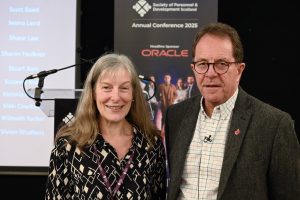
SPDS Treasurer, Glenda Gray, with Peter Cheese
Blog by Katie Jacobs, an award-winning freelance journalist, writer and editor, who specialises in writing about the world of work. She was previously Editor of HR Magazine and Senior Stakeholder Lead at the CIPD.
0 Comments