
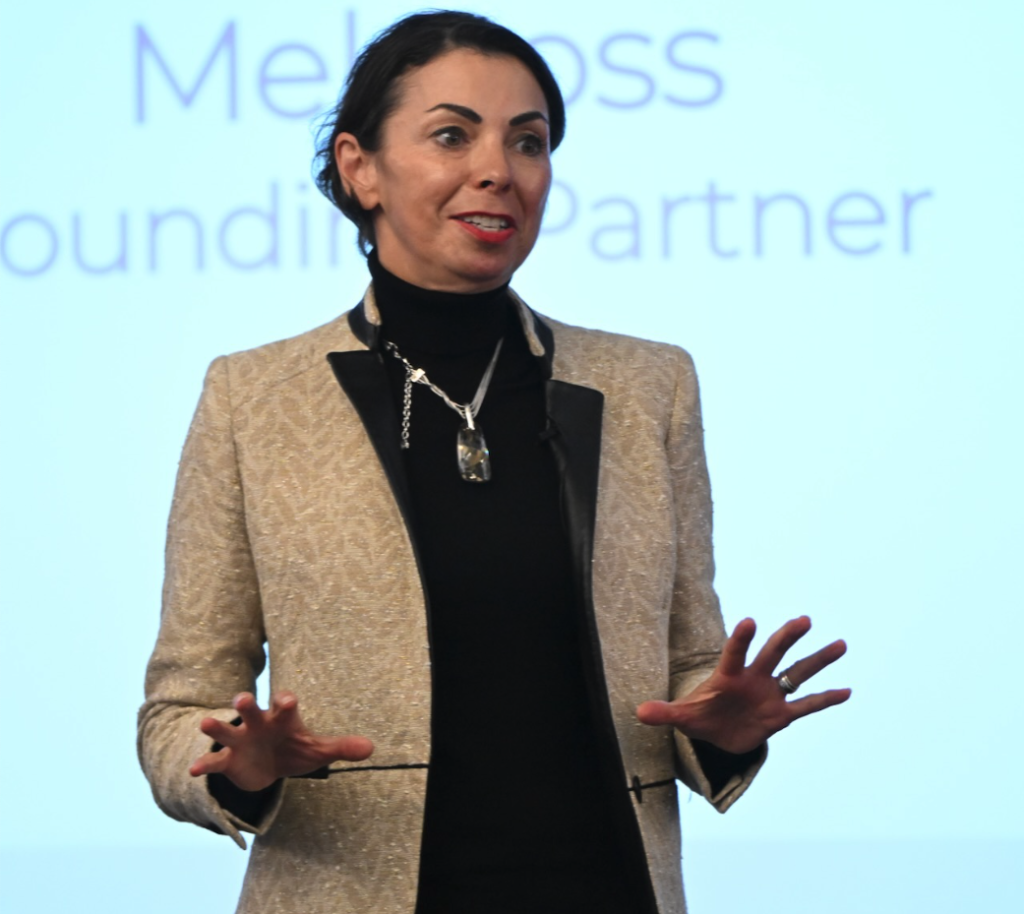
Leaders, organisations and the HR and OD profession itself are at “an inflection point”. That’s according to Mel Ross, founding partner of Adapt2Digital, who told the SPDS Annual Conference that she believes the concept of digital transformation is going to move “to the place where it should sit: with the custodians and stewards of the workforce”.
That means digital leadership becomes an essential skill for all HR and OD professionals as we move into 2027, what Ross called “the first year of the new normal”. “It’s all about human-centredness, humanity, workforce, leadership and bringing the human into the centre,” she said.
But leading in this new normal means flipping the script on transformation. Rather than thinking of digital transformation as a process with beginning and end, think about “a digitally transforming human system”, because change and uncertainty “are here forever”. “How do we transform ourselves to get up to speed with what has already transformed around us?” Ross asked. “That’s a human challenge, a human opportunity.”
Role-modelling will be critical to people adopting technology. Ross described digital leadership not as a skill, but an identity. “It’s not a skill. It is about who you are,” she said. “How do we break the habit of being ourselves, so we don’t go back into our silos and don’t revert to patterns of fear when presented with something new that might be an opportunity.”
According to Ross, there are seven dimensions of digital leadership, seven areas where leaders need to shift their mindsets:
- Digital native: A mindset that is ready for a world driven by technology and enabled by AI.
- Flexible: A mindset is one that is adaptive (able to change in one direction), agile (able to step in any direction) and nimble (able to pivot).
- Networked: A mindset that is fit for a world where we’ve never been more connected, and yet where people feel disconnected.
- Open and authentic: Speaking truth to power, and applying discernment when it’s hard to find the truth.
- Data mindfulness: Data literacy and fluency, with an awareness that everything is data: body language, speech, energy.
- Future focus: Designing from an emerging future, one that is constantly unfolding, rather than a utopian 30-year vision.
- Humanity-centred: Stewarding the ecosystem the workplace operates within, considering safety, security, environment, community and the planet.
When it comes to embodying this digital leadership, Ross advised leaders to commit to “1% a day – about 10 minutes”. “The consistency is where the secret sauce is,” she added, rather than blocking out a Friday to become “a changed person on Monday”.
She added that leaders should no longer view AI as a tool, instead viewing “human plus AI” as the new normal and the new workforce. Ensuring we as humans continue to “feed ourselves with creativity, intuition, critical thinking, discernment, instinct and wisdom” is critical. And as AI is neither “good nor evil – it’s the humans that use it”, ethics must be front and centre.
“AI isn’t a trend: it’s an inevitability,” Ross concluded, adding it’s less likely that AI will take your job than another human who has integrated AI into the way they work. That means HR and OD professionals need to think “what if”’ they became “the custodians and stewards of the new workforce that is human plus AI” and “role models of digital leadership to help accelerate human transformation”.
View the presentation here.
Blog by Katie Jacobs, an award-winning freelance journalist, writer and editor, who specialises in writing about the world of work. She was previously Editor of HR Magazine and Senior Stakeholder Lead at the CIPD.
0 Comments