
With estimates suggesting that around one in seven people in the UK are neurodivergent, they are likely to make up a significant proportion of your workforce. And as awareness of neurodivergence continues to grow, many organisations are increasingly recognising that neurodivergent employees represent an often underutilised talent pool. But despite the best of intentions, traditional workplace practices can unintentionally create barriers to the recruitment, performance, wellbeing and progression of this talent pool.
As Rebecca Wones, Director of Psychology at PAM Wellness (recently acquired by Optima Health), put it at the SPDS Annual Conference: “The challenge isn’t whether neurodivergent employees are in our workforce. It’s whether our systems are enabling them to achieve.”
HR and OD professionals are key to ensuring that organisational systems, policies and cultures are set up to enable neurodivergent individuals to thrive. And with research showing that cognitively diverse teams excel in creativity and problem solving, and demonstrate improvements in productivity and output quality, there is a business case to building neuro-inclusive organisations.
But with local councils facing so many competing priorities and constrained budgets, how do you get it right? In a practical, thought-provoking session, Wones and her colleague Stuart Johnston, Client Director for Neurodiversity, offered the following takeaways for HR professionals.
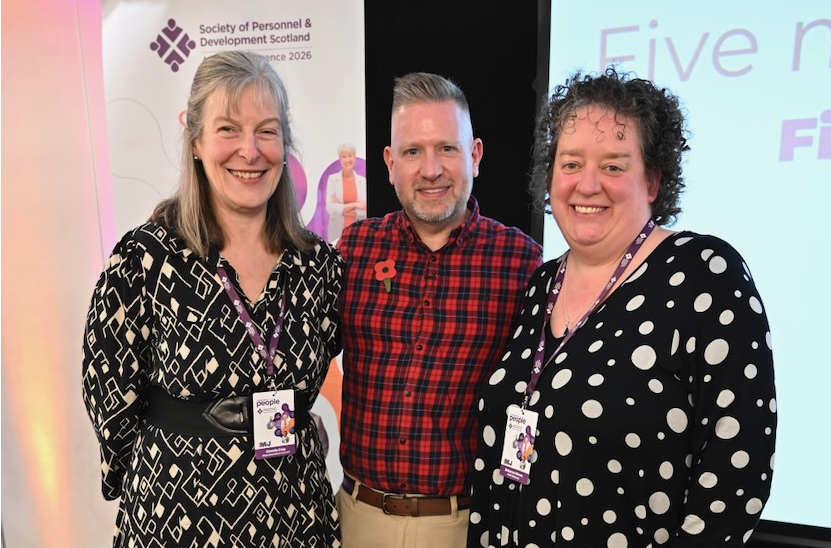
SPDS Treasurer, Glenda Gray with Stuart Johnston and Rebecca Wones from Pam Wellness
Picture by Stuart Bain
1. Fix the system, not the employee
“Instead of fixing somebody, let’s build better,” Wones said. “Let’s think about our systems and our processes.” This means looking across the whole employee lifecycle, considering how neuro-inclusive different people processes are.
For example, when it comes to recruitment: are your job adverts neuro-inclusive? Does your website have a clear inclusivity statement, and is it easy to find? During the interview process, you could consider providing questions in advance, using work-based assessments or offering alternative interview formats. And during onboarding, are you offering people the opportunity to access support and adjustments from their first day? These are good practices for everyone, not just those who are neurodivergent. As Wones said: “Good neuro-inclusion is good inclusion. It supports everybody.”
2. Co-design with neurodivergent individuals
Small changes across roles, teams, culture, systems and processes can have a big impact on neurodivergent individuals. And asking those people for their opinion on what needs to change is equally powerful. “It’s ‘nothing about us without us’,” said Wones. “Include your neurodivergent workforce in what you are doing. They know their jobs. They know they know their neurodivergence.”
Ask for their advice on the practicalities of making changes too, she advised. “Ask their opinion and understand where they need support or where support and systems can be different. [Ask:] but how do we actually do that? What do we put in place?”
3. Support and educate managers
Managers confidence varies. However well-intentioned the manager, they are often unsure how to address performance or communication issues, or even how to offer support. “It could be down to the manager being scared to put things in place in case they’re doing the wrong thing,” said Johnston. “It is all about education and awareness.”
Managers should be empowered to act locally. For example, Wones said, buying a pair of noise-cancelling headphones for a colleague shouldn’t require permission or an assessment. “Workplace adjustments can be viewed as exceptions; other team members may be questioning: why have they got that?” she added. So, managers also need to be supported to manage communications about adjustments across their team.
4. Look at the resources you already have
Not all support has to be expensive: there are immediate, low-cost actions you can take to support your neurodivergent workforce. “Make sure your staff are fully aware of the features and benefits of the programs already installed in your organisation,” Johnston advised. He gave the example of the Teams transcription function, adding that HR professionals should check with their IT teams about what assistive technology the organisation already has.
There are plenty of free resources available. PAM’s website and YouTube offer free webinars and other resources. And check whether your occupational health provider offers neurodiversity support. “What one tiny thing can you do on Monday morning around this?” Wones asked. “If you’ve got an overall inclusion policy, is neurodivergence mentioned in that? What assistive tech can you get access to without having to jump through hoops?”
5. Don’t wait for a diagnosis to offer support
Employers don’t need a diagnosis to offer an employee support. “If someone says: ‘I think I might have autistic traits. I’m struggling. I need some support’, just put the support in,” advised Wones. “They don’t need that diagnosis to get support in the workplace.”
Be aware that a diagnostic assessment won’t tell you what adjustments to make. To identify reasonable adjustments – a legal requirement – you need to commission a workplace needs assessment. “The diagnostic and screening process is about the person,” Wones explained. “The workplace needs assessment is about their job: their challenges, strengths, adjustments and supports.” And there is a cost to not offering support: Johnston warned that employment tribunal cases for failing to make reasonable adjustments are rising.
6. Recognise and use neurodivergent strengths
Wones urged delegates to “reframe” the challenges of supporting neurodivergent talent into “seeing them as strengths when somebody has the right support”. Neurodivergent strengths often include creative problem solving, independent thinking, attention to detail and honest, direct communication.
“Neuro-inclusive practices build empathy in a workplace,” she added. “They can help create psychological safety, strengthen morale, build resilience in people and create future-focused organisations.” Fixing the system to be more inclusive of everyone rather than seeking to fix an individual is where you will get those strengths “shining through”, contributing to the performance of the organisation as a whole.
View the presentation here.
Blog by Katie Jacobs, an award-winning freelance journalist, writer and editor, who specialises in writing about the world of work. She was previously Editor of HR Magazine and Senior Stakeholder Lead at the CIPD.
0 Comments