
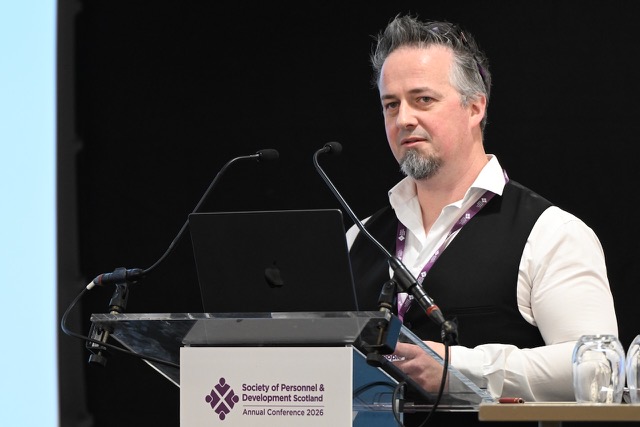
“What does it cost us when we put the word ‘council’ in front of a job?” That’s the question Stephen McCurry, Director of Digital Services and Finance at NEREO, asked the room at the SPDS Annual Conference. It’s a challenging recruitment landscape for local councils; McCurry described “roles that are harder and harder to fill, fewer applications for certain vacancies, a workforce that is getting older and younger people who simply don’t picture a council when they picture a career.”
Drawing on the results of a survey of conference delegates, McCurry said that what matters most to people in a job is workplace culture and the people they work with, followed by salary and meaningful, purposeful work. But when asked what words came to mind when thinking about what it means to work for a local council in Scotland, the single most common word was undervalued. “This is a room full of people who work for councils and believe in them,” said McCurry. “If that’s what we think, imagine what someone in the outside world thinks.”
Just over half of delegates said they would feel proud to tell people they worked for a council. “If we’re not sure we’d say it proudly, why would anyone else?” asked McCurry. Three-quarters of delegates said they expect the public to see council workers negatively, but only a quarter think the public view council jobs as a quiet life. “The stereotype isn’t that council staff are lazy… it’s that council work is undervalued,” said McCurry. “That is a very different problem to solve.”
Delegates were asked about two identical jobs, one advertised by a private company and one by a council. When asked how much more the council job would need to pay to be equally attractive to a private sector worker, the most common answer was between £5,000 and £10,000 a year. One in six said no amount of money would close the gap, and only one in five thought the two jobs should be seen as equal.
The room said that pay is the biggest barrier between private sector and council jobs, with just over a third of delegates citing lower pay ceilings. Council image and not being on people’s radar are another two challenges – as McCurry put it: “How councils are seen, or whether they are seen at all.” While pay and processes are issues for individual councils to address (delegates also raised bureaucracy as a common challenge), improving image and visibility is a collective effort. “It’s something we only fix together,” said McCurry.
NEREO and SPDS are running a four-part research programme and national recruitment branding pilot, consisting of two public surveys (people outside the public sector and those within the sector), interviews with private sector voices, who have either moved into council or applied but later walked away, and a job choice exercise to put a firm figure on the cost of the word council. The aim is to create a shared story. “No single council can change how the word council sounds, but together we can,” said McCurry. “We speak louder when we speak together.”
View Stephen’s presentation here.
Blog by Katie Jacobs, an award-winning freelance journalist, writer and editor, who specialises in writing about the world of work. She was previously Editor of HR Magazine and Senior Stakeholder Lead at the CIPD.
0 Comments