
The employment law team from Clyde & Co, Stephen Miller, Graham Mitchell and Frances Ross, gave SPDS delegates an important update on all things employment law.
These are some of the questions submitted by the SPDS Employment Law group that they covered during the session.

Stephen Miller, Graham Mitchell and Frances Ross, Clyde & Co
Pictures by Stuart Bain
1. After the Supreme Court decision on part-time workers, is it a risk if overtime enhancements are only paid once someone exceeds, say, 37 hours?
This is based on the case of Augustine v Data Cars, which Ross clarified is not actually about overtime. In this case, a part-time private hire driver paid the same weekly charge to access the booking system as a full-time driver, making the charge far more expensive for him per hour. “He claimed less favourable treatment under the part-time worker regulations, which protect a part-time worker from being less favourably treated than a comparable full-time worker,” Ross explained.
The Supreme Court held that part-time status doesn’t need to be the sole cause of less favourable treatment. It’s enough that it’s an effective cause, consistent with the causation approach applied in discrimination law more generally. This is a change for Scotland, Ross explained. “The effect is to reduce the scope for employers to rely on causation to defeat claims,” she said. “It shifts the focus onto justification.”
The case confirms that “pro-rating should work both ways”, she advised. “If you pro-rate benefits, also pro-rate requirements and expectations.” She added that the case could lower the bar for part-time worker claims: “So, for example, if part-time workers were required to work a greater proportion of their hours at weekends, it could be easier for them to establish that type of claim.” Employers should review any hours-based arrangements.
2. How and when should sexual harassment allegations be recorded in health and safety and risk systems, when an investigation hasn’t concluded?
Ross clarified that when it comes to sexual harassment, employers have two overlapping duties. Firstly, those under the Equality Act, including the newly strengthened duty to take all reasonable steps to prevent sexual harassment. The second is the duty under regulations made under the Health and Safety at Work etc. Act 1974. Sexual harassment is not a RIDDOR category under HSE law and is only reportable if there is a physical injury meeting specific criteria.
However, when dealing with sexual harassment internally, Ross added that “recording and reporting for health and safety purposes [may be] a separate stage from the investigation and findings”. She advised three separate stages of reporting. Firstly, reporting that an allegation has been made. Next would be an initial risk assessment to see what immediate steps need to be taken, for example temporary separation of employees, home working or changes in working patterns. The third stage is to investigate and reach findings under the appropriate HR process (grievance, anti-harassment etc.).
“When you’re recording the matter for health and safety purposes, [don’t] record the report as fact,” she said. “You may want to expressly note that what you’re documenting is an allegation, that no finding has been made, and that it will be investigated under the appropriate process.”
She also clarified some of the risks around making apologies, advising that when recording a report “there’s nothing wrong with expressing empathy and offering welfare support”, it is important to avoid language that “makes any factual or legal admission because it hasn’t yet been investigated and established”. Appropriate wording might be: “I’m sorry that you’ve had this experience. We take what you’ve reported seriously, and it will be investigated under the appropriate process.”
After findings, HR professionals should still be careful that what they say doesn’t go beyond what they believe happened, because it may be relied on in legal proceedings.
3. Have there been any developments on workplace access to single-sex facilities?
Since the 2025 Supreme Court ruling in the For Women Scotland case that confirmed the terms ‘sex’, ‘man’ and ‘woman’ in the Equality Act refer to biological sex, Ross said there have been “a number of tribunal decisions and a High Court judgment, which shed a little more light on matters”, as well as the updated statutory EHRC Code of Pratice on services, public functions and associations.
There have been three recent tribunal decisions, which Ross acknowledged “don’t sit well together”:
- Kelly v Leonardo: A policy allowing toilet use by gender identity. Claims were dismissed. The tribunal held employers don’t need to guarantee single-sex women’s spaces are reserved for biological women. It is relevant that there were single-occupancy alternatives available to the claimant.
- Peggie v Fife Health Board: While the initial decision to let a trans woman use the female changing room wasn’t inherently unlawful, once the claimant objected, the failure to revisit the arrangement, at least on an interim basis, was harassment. The decision is subject to appeal and HR professionals should keep an eye on it.
- Hutchinson v County Durham and Darlington NHS Trust: Female staff using a communal changing room to which a trans woman had access raised concerns. These concerns weren’t taken seriously. Harassment and indirect sex discrimination claims succeeded. Contrary to Kelly, the tribunal held employers do need to guarantee that women’s single-sex spaces are restricted to biological women.
Ross also covered the EHRC’s Code of Practice on services, public functions and associations. While it doesn’t cover employment, it may nevertheless be informative, particularly where facilities are shared by staff and members of the public. The code states that single-sex services should be based on biological sex. Admitting people by gender identity is likely to lose the protection of the statutory exceptions.
Proportionality and balancing are key, including the impact on trans people who are excluded. Ross noted that single-sex facilities accessible by gender identity are “very likely” to be unlawful sex discrimination against the opposite sex. The EHRC’s view seems to be either fully gender-neutral or single-sex by biological sex, she said.
This is a sensitive and evolving area and Ross offered some practical advice:
- Audit current facilities and arrangements and how they could be adapted.
- Assess impact and options, including consulting different groups.
- Maximise options where possible. Don’t just default to the accessible toilet.
- Be ready to respond to concerns and complaints. The case law shows that getting this wrong is often decisive. Consider interim arrangements while a concern is investigated, be sensitive to different viewpoints and record your reasoning – because “almost inevitably you’re going to be making a decision that not everybody is happy with”.
4. Should employers ban smart glasses or have policies around them?
There is no law that gives employees a right to wear smart glasses, and none that prohibits them either, Mitchell explained. Such glasses are already partly covered by existing data protection rules and policies; the issue is that they can record and broadcast live covertly.
Mitchell cited various actions that bodies and companies have taken as an indiction of the direction of travel in this space. HM Courts & Tribunals Service has prohibited Meta/camera-equipped smart glasses in courts and tribunals in England and Wales, and the NHS is considering restrictions in hospitals. Pub chain Wetherspoons has banned them, as has Clyde & Co (except in the case of genuine reasonable adjustments).
Mitchell said that EU data protection guidance expects smart glasses to indicate whether they are recording, either via light or sound. Norway has proposed legislation for a temporary ban on wearing of all AI glasses in selected places, such as doctors’ surgeries, gyms, leisure clubs, public parks, public beaches and museums.
Mitchell cited the risk of covert recordings of disciplinary or grievance meetings being used as evidence. In Amwell View School v Dogherty (2007), an employee secrectly recorded disciplinary and appeal hearings, including the panel’s private deliberations. The EAT held that the recording of the open hearing was admissible, but the recording of the private deliberations was not, on public policy grounds. But later cases have gone the other way. “I suspect a lot of companies are saying ‘let’s just ban this’ [as they] don’t want to be caught having a debate on that fine line as to whether that’s admissible or not,” he said.
“Legislation will come, but it’s extremely complicated,” he concluded, adding that blanket bans can mean you “lose the benefits of some of these technical advancements”.
5. What other AI-related employment law developments should HR professionals be aware of?
Mitchell and Miller offered a quick round-up of other developments around AI, particularly related to grievances:
- In the Australian equivalent of tribunals (the Fair Work Commission), parties must now declare any generative AI use in preparing documents and explain how it was used. A person must check that case citations are real and support the point made (and professional representatives must hyperlink case law), and witness statements must reflect the witnesses’ own knowledge and words. Breaches can lead to documents being given less weight, costs orders or dismissal of the case. UK employment tribunals are starting to give more directions too.
- Be aware of Grapple Law, an online service that turns employees’ complaints into grievances in return for 10% of what they recover.
- Go back to basics on responses to grievances. It is OK to ask an employee with a 50-page AI grievance to clarify what they are aggrieved about, and to work with them to list the actual points.
- Remember that AI prompts may be retained and may potentially be disclosable in litigation. A prompt like: “How do I get Charlie out?” could surface at tribunal.
- If managers are using AI to draft disciplinary outcomes and grievance outcome letters, they must still own the reasoning and be able to discuss and defend it if required in a tribunal.
- Interim relief applications in Scotland have gone from about 20 a year to about 20 a month, driven by AI tools listing it as a remedy. However, few succeed.
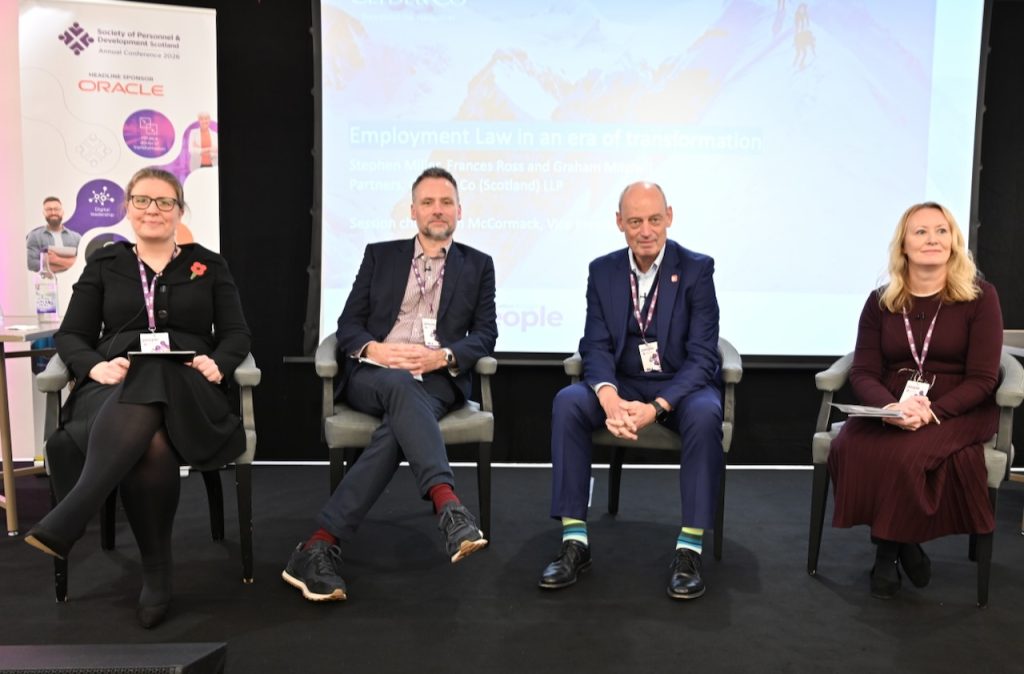
Frances, Graham and Stephen with SPDS Vice President, Kath McCormack, who chaired the session
All photos by Stuart Bain
Blog by Katie Jacobs, an award-winning freelance journalist, writer and editor, who specialises in writing about the world of work. She was previously Editor of HR Magazine and Senior Stakeholder Lead at the CIPD.
0 Comments